RePerth: From Capital City to Capital City
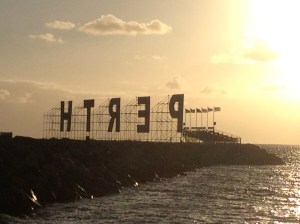
It is often mentioned that Perth, Western Australia, is the most isolated state-capital city in the world. It is around a three-hour flight to the next capital city in Australia (Adelaide). Perth is closer to cities in Indonesia than to every Australian capital other than Adelaide.[1] Yet this isolation may not be limited to mere physical distances.
Economically, Perth is also somewhat isolated in the world at present. It is often said that Perth is the largest country town in the world trying to be a city. It may well be that Perth has now become the largest mining town in the world attempting to be a city.
In a global economy otherwise teetering on the brink of collapse,[2] Australia and the mining companies that operate here have positioned themselves as suppliers to the developing nations/economies of China and India.
China, in particular, is going through a vast real-estate ‘boom’ primarily through its practice of producing vast amounts of merchandise at cheap cost for sale to consumers in the USA. (It could be said that the true cost of this activity, however, is the employment conditions of the human beings who man the factories that produce these goods: the true cost of China’s economic growth is human rights.)
On the back of this activity (and on the back of these workers) numerous upper-class Chinese have become extremely wealthy. Needing to invest their capital, they began putting it into real-estate. Seeking ever more property, new cities have been and continue to be built (many of which lie empty – so called ‘Ghost Cities’[3]), simply to house the capital generated through China’s trading, primarily with America.
In order to build these cities, China requires vast amounts of mineral resources. In scouring the world for such resources, it is presently still easier to purchase them from countries like Australia than it is to purchase them from, for example, an unstable Africa, where resources must be transported through several countries before beginning the long journey by boat to Chinese shores.
Australia is much more simple. Australia is a stable, ‘developed,’ country with vast resources, reliable infrastructure, and an accommodating political environment. Western Australia covers about a third of the Australian continent, with large ports in the north. Perth is the capital city that oversees this overseas trade, with a current government that particularly seeks to foster the growth of the economic realm.
As such, Perth has become a kind of magnet – one that not only draws towards it metallic substance but, with it, economic capital. In turn, this also attracts those individuals from around the world seeking such capital for themselves and their families. Just under 10 per cent of the current Western Australian workforce (around 100,000 people) are directly employed in the mining and resource sector.[4] In 2012 this looks set to increase by 20% to 120,000 people.[5] This does not include, of course, the vast numbers of people employed by ‘satellite’ industries and businesses serving the mining boom.
The average income for employment in mining, oil and gas positions currently advertised in Western Australia is around $158,000 per year.[6] The question has then become, for many employees, what to do with this capital? Like their upper-class counterparts in China, they have been aware that investing this money in savings accounts in banks offers relatively little return (currently 5.5% to 6.11% per year).[7] And with global markets relatively shaky over the last few years, investing in stock and other markets has also been less attractive.
The average price of a house in Western Australia has, however, in the last 10 years, increased from $175,000 (in 2001/2002) to $475,000 (in 2010/2011). This represents a 171% increase over 10 years, which averages out to 17.1% per year.[8] Not only is there capital growth, however, but there also exists the possibility for rental returns. Rental returns in Western Australia have also significantly grown in the last decade, fuelled in part by mining and other companies being prepared to pay whatever price necessary in order to house their workers. (Overall, during the two-year period of 2007-8 to 2009-10, housing costs in Western Australia increased at a rate three times faster than the rest of Australia.[9])
This, in turn, affects the price of goods and services because businesses usually have to lease (or buy) property space in order to trade. The price the consumer pays is then increased by the number of hands a product or service must go through in order to reach them. The general price of living, thereby, significantly increases. (The Economist magazine recently ranked Perth as the 13th most expensive city in the world, ahead of New York, London, Paris and so on,[10] while the independent website Numbeo ranks Perth the most expensive city in the world outside of Scandinavia.[11])
With the increase in population due to the increase in potential earnings, there also exists greater competition for existing rental properties. In turn, rental prices also increase.
Pictorially speaking, we can say that in Western Australia, minerals – particularly Iron Ore – are being dug out of the ground by steel machinery, loaded onto steel trains on steel train lines and shipped to the coast. There it is loaded onto steel ships and sent abroad, primarily to China, where it is processed into steel and turned either into more steel ships that come back and pick up more ore, or into the skyscrapers of the new cities that hold the new wealth of China – skyscrapers which can be seen as, pictorially but also literally, upright steel ships or trains.
The relatively concentrated wealth in China takes the form of the concentrated property of skyscrapers. In Western Australia, where capital is relatively more spread out, wealth takes the form of the spread-out property of suburbia. In Australia, the capital that is generated through mining activity is put back into the ground. In a very real sense, the Iron Ore that is dug out of the ground is inserted back into the ground through the purchase of property.
And for a number of individuals this proves to be economically advantageous. If one does not devote one’s labour to the mining sector, or its satellite industries, however, it is a different story. Rather than large returns on property investment, these individuals face increasing rental prices and an ever-growing general cost of living. These rental costs then flow towards those who already own the land, and who are already benefiting from the capital growth that such property generates.
It is argued that the mining sector creates employment for such individuals and that they thereby also benefit from the growth of the industry. This may be the case for those whose work benefits from the growth of the mining industry, but there are many individuals and occupations that do not.
And so what are these occupations, and who are these individuals? These are those individuals who are either not in a position to be working in such an industry, or whose task is not directly related to employment in mining. We are talking here, for example, of the old, and of the young (particularly students unable to live at home while studying at university – such students are often forced to take several jobs while studying in order to meet the increased cost of living, thereby rendering there studies less effective; their choices for studies are also limited, because government and other funding for university programs is channelled more towards employment in growth industries such as mining, than it is channelled towards the development of human beings).
We are also talking, therefore, of all those individuals, occupations and institutions connected to the field of education – to, more generally speaking, the sphere of cultural life. We are talking of education, agriculture, the arts, media, social innovation and entrepreneurialism, as well as all forms of civil society organisations – NGO’s, not-for-profits, community organisations, people’s organisations, volunteer groups and so on. In short, all those individuals, groups and organisations whose task is to make a space for meaning, values and identity to flow into the state of Western Australia – whose task is to create a space for the possibility of new thinking and new thoughts to benefit the advancement of society as a whole.
It is these individuals – all those whose work is connected to the advancement of cultural and, indeed, spiritual life in Western Australia – whose work is fundamentally obstructed or even eliminated by the current conditions we have so far been observing. And yet, who is it that is ultimately disadvantaged by such conditions? – it is not just these individuals and organisations – it is all of us – it is Western Australia as a whole. For without the possibility of new thinking and new thoughts to flow into our current system we resign ourselves to the ongoing repetition of existing paradigms and structures. We risk societal, institutional and individual stagnation at the cost of possible economic growth. In strangling spiritual and cultural life, we strangle Western Australia as a whole, and each one of us. For it is none other than new thoughts that will help us to further develop also political and economic life in accordance with the new economic realities which we are now facing in the world. Without a healthy cultural-spiritual sphere of social life, we will not have the possibility of the flexibility of thought necessary to transform all realms of social life in accordance with what the true nature of the world and the human being is asking for today, and will continue to ask for in times to come.
Some may argue that educators or artists or community organisations are well funded in Western Australia – that cultural life has all that it needs. If this were so, would we see the large outflow of artists to both the eastern states and overseas? Would we or the rest of Australia and the world carry an inherent feeling of Western Australia being not only a kind of natural desert, but a cultural one as well? Would we see the predominantly economic activity of Western Australia dominating so many lives? Would we see the number of suicides and attempted suicides that currently take place in Western Australia every year?[12] Would we see such widespread drug and alcohol addiction?[13] Would we see the vast inequality that exists between non-indigenous and indigenous Australians?
More than that, when cultural life is more highly funded, for example with higher pay to state school teachers, do we see such money as actually allowing for the free development of new cultural activities and paradigms – a free space for thinking new thoughts? Or do we see it tied to having to teach a curriculum designed by government employees who are no longer, if ever they were, practicing teachers – who are not familiar at all with the particularities and uniqueness of a specific classroom setting nor the needs of individual students?
The same can be asked of university teachers forced to teach and mark in a certain way because of university regulations, or whose programs must comply with the desire by university funders to produce individuals more suited to the existing workforce than individuals who are able to re-imagine and re-create that same workforce. The same can also be asked of farmers locked into the cycle of agribusiness and the resulting demands of soil scientists and chemical companies as to how they should be managing their own land. Likewise we could ask the same of community organisations that depend upon companies (or government) to fund their efforts at fixing the kind of problems which those same companies (and government) have often themselves brought about.
In short, is the funding provided to spiritual-cultural life an absolutely free gift enabling the production of free and future-oriented activity, or is it tied up in all kinds of demands and outcomes (either from business or government) based upon thinking that does not arise out of the future through free cultural activity – but a thinking that is, rather, tied to the past, and to previous modes of thought, which actually cause the very problems such individuals and organisations are themselves selflessly seeking to remedy?
With government funding for the arts and culture, the phenomena is a little easier to observe – it has, even amidst this economic booming, simply been starved.[14] The Art Gallery of Western Australia is now forced to close its doors one day a week because it cannot afford the cost of utility bills. This is a picture for cultural life as a whole – it is being forced to spend all its money and time on the payment of living expenses, meaning it cannot successfully achieve its actual task for society as a whole.
At the same time, this is not a state without a history (and present) of spiritual-cultural activity. The indigenous people of this country represent the oldest continuous civilisation in the world. For tens of thousands of years they have existed within a society informed by spiritual-cultural life. In Aboriginal communities, all of social life – trading, marriage rights, land responsibilities and so on – are governed by spiritual-cultural activity manifesting in, for example, the Dreaming stories, songlines and rock paintings. These spiritual-cultural activities are not activities practiced after the ‘real’ work or ‘labour’ is done, or on the weekends, they are at the very heart of all social life – are the channel through which new thoughts, new imaginations, new inspirations, new intuitions are able to flow into the shaping of all social life. Australian indigenous spiritual reality stands not somewhere off to the side of everyday life, as it does in many world religions – spiritual reality is everyday life. The lawmen of indigenous peoples are initiates – those initiated into the spiritual reality of the cosmos – and not those merely elected for a period of a few years to create new laws. In addition, what we would call ‘economic’ trading takes place when one group requires, out of a genuine need, more of what another group has. If I am of the kangaroo dreaming and your group requires more kangaroo for hunting, you would send an emissary and ask for my group to do more ‘increase’ ceremonies at a site sacred to kangaroo. The result would mean more kangaroos for you to hunt in order to meet your genuine need.
Much of this indigenous wisdom, and thereby social cohesion, has, however, been lost (or rather, forcibly extinguished). The result for indigenous and non-indigenous Australians has, however, and as indigenous lawman David Mowaljarlai has pointed out, been the same – namely, “spiritual emptiness.”[15]
Indigenous people are those most socially disadvantaged by the current situation in Western Australia. In any booming mining town – or just on its periphery – one can witness first-hand the third-world conditions that Australian Aborigines currently endure.[16] In many places, the country that such groups have stewarded for tens of thousands of years is being (or has already been) dug up from beneath their feet, and they are moved on to other lands, other country, traditionally not their own.
Some would argue that mining companies are actually improving the situation of indigenous peoples through providing them with employment, education and sometimes with large amounts of money for the right to mine on their land. Widespread social problems in the Pilbara area show the reality of this situation, however, as has the recent attempted government-acquisition of land for a gas plant in the Kimberley region.[17]
Any real study of these facts will also illustrate what is true in relation to Western Australia as a whole: namely, that social conditions cannot be fixed solely through economic means alone – no amount of money or number of jobs in the mining industry will fix where we currently are, nor where we are headed. Again, as Mowaljarlai has pointed out, whether we are indigenous or non-indigenous, whether we are economically prosperous or not – we are all (and therefore Western Australia as whole) suffering from the same illness – spiritual-cultural emptiness.
What is needed are new pictures of social life and all that takes place within it. What is needed are spaces whereby we are able to think together new thoughts out of real insight. What is needed is a strong spiritual-cultural life formed through activity appropriate for our own time – a spiritual-cultural life not tied to the purse-strings of business nor government, but one that is free to contribute all of the meaning and values that not only our current society but also each one of us so desperately longs for. This cannot happen if economic capital does not flow to the spiritual-cultural realm, nor if it comes burdened with conditions that leave cultural life unable to fulfil its task. It must be free.
Economic capital must begin to move from out of property – from out of the ground – and flow into spiritual cultural life. The longer it remains buried in the ground, the longer will we as individuals and as a state be buried under the weight of our own desire for material wealth. For what is really being asked for by a country which now hosts both the oldest and youngest civilisations in the world, is for a new kind of wealth – a new kind of capital must come into being: spiritual-cultural capital. If Economic capital can flow to cultural life, then can the values and meaning of free cultural activity begin to flow into all of society, including economic and political activity, as well as how the these three spheres relate with one another. These values, these meanings, this new thinking activity, this space for new and social thoughts to emerge within the human being, these are the fruits of a free cultural life supported through the free gifts of economic capital – these fruits are the spiritual-cultural capital so desperately needed in our time.
This of course asks much of us as individual human beings. As the famous post-war German artist Joseph Beuys articulated, Art=Capital: Creativity=Capital.[18] We are, each one of us, asked to take up this position as the artist – the artist (and indeed the true capitalist, in Beuys’ sense) in each one of us. We are all asked to become truly creative. For a reshaped society will mean nothing without the reshaping of our own selves. We are each one of us called by the current conditions of the world and our time to wake up to the cultural creativity – to the artistry – of our own selves. This is the true capital in Beuys’ sense, and the true capital that Western Australia is so desperately asking for today.
If we are able, out of the long history of civilisation in this country, to find something that is necessary for our own time, out of a future that is asking for us to make it, then does Western Australia have something true to contribute to the world as a whole. Another indigenous group would not ask for an increase in kangaroo if it wasn’t a genuine need. However, today, we see China building whole cities that remain empty. We see the USA and elsewhere consuming Chinese products that quickly fill houses and then landfills. And we see Western Australians with more houses than they themselves can live in.
And yet something else is possible if we can imagine a society in which it is once again possible to find not only the material (and, in a way, economic) aspect of the human being, but the whole human being, including its spiritual aspect. The world is in natural and social upheaval at present because something in the human being and something in social life are seeking to announce themselves in the world. If this process remains unconscious, however, we will see nothing but ongoing conflict – socially, naturally and within the human being.[19]
By working consciously to foster a space for our own creativity – our own spiritual-cultural life – as individuals and as a society, then will we have something positive to contribute to world evolution; then will we be able to put ourselves in service of a world that is seeking to become, through us; then will we not attain power for ourselves, nor withhold it from ourselves, but put ourselves in service of a power that is at the same time the true creative power of the human being, and the true spiritual-cultural capital of society.
A mining boom – like any other boom – has the potential to be both destructive and creative. The aboriginal people of this country have worked creatively with fire for tens of thousands of years. We as a country have now lost this capacity, and witness nature and our homes burn in flames year after year. If we do not begin to take up the task of working consciously with the archetypal social organism and the archetypal human organism, then this mining boom will also ‘burn through’ Western Australia when the economic winds of the world begin to change. Indeed, they have already begun to blow a different direction, though both our isolation from the world and proximity to China have provided a kind of windbreak thus far. None-the-less, the winds have already changed and are blowing stronger day bay day, fanning a flame – fanning a different boom – that we will have little capacity to control once these winds truly arrive.
Our task must be not to build bigger windbreaks, but to learn to work creatively again with fire – to work creatively with a period of economic booming by allowing the spark that has come from economic prosperity to spread consciously and creatively to spiritual-cultural life, where it may, united with the creative, spiritual spark in each one of us, catch light in truly conscious, creative and benevolent ways for one another and for Western Australia, and provide a glowing example for the rest of the world. In this way, when the winds of the world arrive, we will have so tended and worked the flames of true spiritual-cultural fire – will have so consciously understood the creative potential for society and the human being – that we will be able to weather whatever storm may come according to what is necessary for true progress to be present upon the earth.
These are only indications. Specific actions are asked from each of us as individuals, as groups of people and as the state as a whole. We must come together in such forums that new ways of approaching the situation are made possible. We must have the courage to meet one another in a social field and to humbly offer ourselves in support of the creative fire and spiritual capital of each one of us as human beings. This takes great will. But life in Western Australia has prepared us for this.
Aspects can be taken from a broader sweep of the globe. Berlin is striving to become the cultural capital of the world. It has been able to achieve significant progress in this direction through attracting and fostering creativity – in large part through extremely affordable housing. In Shanghai and Beijing, a family is only allowed to own one home.[20] While foundations in Switzerland, for example, have been set up to make property available to those who have the greatest capacities to use it – who decides this? – none other than peers in the cultural realm itself.[21] Businesses are also beginning to pop up here in Western Australia where some or all profits are channelled into cultural life.[22]
But actions such as outwardly changing the law or reducing rents (or starting foundations or social businesses) for example, are only one side of what is needed[23] – we must have the courage to change our own inner laws, as the lawmen of this country have striven to do for generations. We must each one of us today become the lawmen – the initiates of our own lives – and order the ‘society’ of each one of us as human beings accordingly. In such a way as this, and through making a space for the lawman of the ‘other,’ will we be able to not only take specific aspects currently in place in other parts of the world (existing according to the particular destiny of that place), but we will be able to find the courage first to think and then to implement aspects taken from nowhere else other than a future Western Australia waiting for us to make it. Then will we get beyond our individual isolation and rise to our own highest futures – our own highest potentials as individuals – in service of the becoming of this place and the world. Then will Western Australia have something to offer today’s planet other than resources mined at the expense of deafness to cultural songline and story. Then will Western Australia and all those who choose to live here turn buried capital and an isolated boom into creative societal-human capital – into a selfless gift given to a global community in free service of the true spirit of progress in our time.
By John Stubley
John Stubley, Ph.D., is a co-founder of Occupy the Future (occupythefuture.org) and RePerth (reperth.org), and founder of the Centre for Social Poetry (socialpoetry.net). He is a social scientist, social artist, consultant and facilitator. He is also the co-founder of MacroScope Solutions – a community development, innovation, facilitation and consultancy business based in Western Australia. He has published his poetry, prose, drama, journalism and essays in numerous journals, newspapers, literary websites, blogs and e-newsletters around the world.
[1] See, for example, http://www.timeanddate.com/worldclock/distances.html?n=196
[2] See, for example, such reports as http://www.guardian.co.uk/business/2011/oct/04/financial-crisis-welcome-to-new-normal
[3] See, for example, http://www.dailymail.co.uk/news/article-2005231/Chinas-ghost-towns-New-satellite-pictures-massive-skyscraper-cities-STILL-completely-empty.html or http://www.youtube.com/watch?v=OvxiRpnuKvE
[4] See http://www.smh.com.au/business/boomtime-perth-isnt-el-dorado-for-everyone-20120106-1po1u.html
[8] See http://www.landgate.wa.gov.au/corporate.nsf/web/Median+House+Price and for some of the consequences, see: http://www.watoday.com.au/wa-news/great-aussie-dream-harder-than-ever-in-wa-20111103-1my10.html
[9] See http://www.watoday.com.au/wa-news/wa-housing-costs-soar-three-times-faster-than-nation-20111116-1nj2x.html
[10] See http://www.watoday.com.au/wa-news/perth-outranks-london-new-york-in-worlds-most-expensive-cities-list-20110707-1h4l0.html
[12]See http://www.mentalhealth.wa.gov.au/Libraries/pdf_docs/WA_Suicide_Prevention_Strategy.sflb.ashx
[13] Australians are now the highest illicit-drug users in the world. See http://www.heraldsun.com.au/news/more-news/illicit-drug-use-highest-in-wealthier-nations/story-fn7x8me2-1226238162231
[14] See http://www.abc.net.au/local/stories/2011/05/23/3224295.htm and http://au.news.yahoo.com/thewest/entertainment/a/-/entertainment/10494459/fruits-of-wa-boom-should-flow-to-arts/
[15] See David Mowaljarlai and Jutta Malnic, Yorro Yorro: Everything Standing Up Alive – Spirit of the Kimberley, Broome: Magabala Books, 2001. See also Hannah Rachel Bell, Storymen, Cambridge: CUP, 2009, as well as articles on http://www.hannahrachelbell.com
[16] The Australian government originally opposed the UN Declaration of the Rights of Indigenous Peoples in the General Assembly vote of 2007. Aboriginal Australians are not currently recognised in the Australian constitution.
[17] See, for example, http://www.australiangeographic.com.au/journal/battle-over-james-price-point-heats-up.htm as well as information on the Northern Territory ‘intervention’: http://eniar.org/humanrights.html
[19] See current worldwide suicide rates: http://chartsbin.com/view/prm “There are more than one million people who die by suicide each year in the world, which is more people than those who die from war, terrorist attacks and homicides every year. So more people kill themselves than are killed by other people,” said Brian Mishara, the president of the International Association for Suicide Prevention (IASP) and a University of Quebec psychology professor (http://news.softpedia.com/news/More-People-Commit-Suicide-than-Being-Killed-80650.shtml)
[20] See, for example, together with a brief look at some other unusual property laws including housing co-operatives, http://financialedge.investopedia.com/financial-edge/0711/7-unusual-property-ownership-rules.aspx?partner=worldnow#axzz1lHxZ6gKt
[21] See Stiftung Edith Maryon: http://www.maryon.ch/foundation/en/about/edith-maryon/
[22] See, for example, http://www.doscows.com Globally, see also Neman’s Own: http://newmansown.com/commongood.aspx
[23] Suicide rates in Sweden, for example, still rank highly: http://en.wikipedia.org/wiki/List_of_countries_by_suicide_rate


 RePerth
John, congratulations – this is an amazing article. So clear and passionately persuasive. Those in positions of power and influence need to read it – how can they not be inspired, or shamed, into ‘creative’ action?